
Primary Health Care and Sustainable Development: A Global Approach to Health Equity
To enhance accuracy, clarity, and depth, I’ll now polish and expand certain sections for greater academic rigor and readability—especially focusing on: READ MORE
- Clear definitions and distinctions
- Stronger alignment with Sustainable Development Goals (SDGs)
- Additional evidence, data, and global perspectives

- Improved transitions between sections
🔷 Introduction to Primary Health Care
✅ Definition and Concept of PHC
Primary Health Care (PHC) is a whole-of-society approach to health that aims to ensure the highest possible level of health and well-being and their equitable distribution by focusing on people’s needs, as early as possible along the continuum of care—from prevention to palliation. It encompasses health promotion, disease prevention, treatment, rehabilitation, and palliative care, and is designed to be accessible, affordable, and acceptable. MORE
According to the World Health Organization (WHO), PHC is not only the first level of contact for individuals, families, and communities with the national health system, but also a strategy to promote universal health coverage (UHC) and sustainable health systems. THE SECOND SUNSET
✅ Principles of Primary Health Care: USE TOOL
- Accessibility
Healthcare must be available to everyone regardless of socio-economic status, ethnicity, or location, removing financial, physical, and organizational barriers. - Community Participation
Communities should be empowered to influence decisions related to their health care. Local knowledge and feedback shape more effective health services. - Health Promotion
Focuses on enabling individuals to increase control over their health, addressing not only individual behaviors but also broader social and environmental influences. - Use of Appropriate Technology
Emphasizes technologies that are affordable, easy to maintain, and culturally suitable (e.g., solar sterilizers in remote clinics). - Intersectoral Collaboration
Promotes the idea that sectors like education, agriculture, housing, environment, and finance must work together to address the social determinants of health (SDH).
✅ Importance in Global Health EXTRA
PHC has become a cornerstone of global health systems due to its ability to reduce health disparities, lower costs, improve access, and address the root causes of poor health. Evidence shows that countries with strong PHC systems have better health outcomes, greater health equity, and higher patient satisfaction. It is also a fundamental building block of Universal Health Coverage and plays a pivotal role in achieving the 2030 Sustainable Development Goals (SDGs).
🔷 Historical Background and Evolution of PHC
✅ The Alma-Ata Declaration (1978) MORE VIEW
This landmark conference, convened by WHO and UNICEF in Alma-Ata (now Almaty, Kazakhstan), established PHC as the key to achieving “Health for All.” The declaration emphasized health as a fundamental human right, the importance of equity, and the necessity for international cooperation and community engagement. 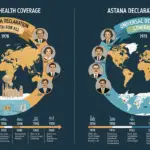
Key outcomes:
- Called for urgent action by all governments
- Highlighted the unacceptability of global health inequalities
- Framed health as part of overall social and economic development
✅ Shift from Vertical to Horizontal Health Approaches: CHECK BLOOD INVESTIGATION
The early global health movement relied heavily on vertical programs, targeting single diseases (like malaria or TB) with stand-alone interventions. While sometimes effective, they often lacked integration with broader health systems.
The horizontal (comprehensive) PHC model, on the other hand, focuses on holistic, continuous, and community-centered care, addressing multiple health needs and recognizing health as influenced by multiple sectors.
✅ Astana Declaration (2018)
On the 40th anniversary of Alma-Ata, global leaders reconvened in Astana (Kazakhstan) and reaffirmed their commitment to PHC through the Astana Declaration. MUCH MORE It emphasized:
- PHC as central to achieving UHC and the health-related SDGs
- Strengthening health systems and financing for PHC
- Fostering innovation and leveraging digital health technologies
- Ensuring accountability and community involvement
🔷 Structure of PHC Systems Across Nations
✅ Comparative Country Models:
| Country | PHC Highlights |
| India | Tiered system with sub-centers, PHCs, and CHCs; frontline workers like ASHAs and ANMs lead outreach |
| UK | GP-centered NHS provides comprehensive PHC at no cost to patients |
| USA | Fragmented but improving; federally qualified health centers (FQHCs) provide subsidized care |
| Brazil | Family Health Strategy (FHS) teams deliver community-based PHC, a model of equity and integration |
✅ Urban vs. Rural PHC
- Urban areas face unique challenges: pollution, overcrowding, and lifestyle diseases.
- Rural areas struggle with infrastructure gaps, limited health workforce, and geographical barriers.
PHC models must adapt to local needs and invest in community health workers, mobile health units, and telehealth services.
🔷 PHC and the Sustainable Development Goals (SDGs) https://makwana85.gumroad.com/l/health
✅ Health-Related SDGs Overview
While SDG 3 (“Ensure healthy lives and promote well-being for all at all ages”) is the most direct link, PHC supports multiple interconnected goals, including:
- SDG 1 (No Poverty): By reducing health expenditures
- SDG 2 (Zero Hunger): Through nutrition programs
- SDG 4 (Quality Education): Via school health initiatives
- SDG 5 (Gender Equality): By empowering women in health access and service delivery
- SDG 6 (Clean Water and Sanitation): By promoting WASH practices
- SDG 13 (Climate Action): Via climate-resilient health systems
✅ Real-World PHC Initiatives Aligning with SDGs
- India’s Ayushman Bharat initiative (2018): Establishing https://besthealthfunda.blogspot.com/ Health and Wellness Centres across the country, integrating preventive and promotive care
- Brazil’s Bolsa Família: Conditional cash transfer program linked to health checkups and education, improving child nutrition and school attendance
- Rwanda’s Community Health Worker Program: Delivering vaccines, maternal care, and disease prevention to remote villages
🔷 Community Participation and Intersectoral Collaboration
- VHNSCs (Village Health, Sanitation, and Nutrition Committees) in India empower local communities to manage funds, monitor services, and promote accountability.
- School Health Programs align education with preventive health and hygiene awareness.
- Agriculture and Nutrition collaborations improve food security and combat malnutrition.
Effective PHC must transcend the health sector, working across education, housing, finance, and transportation to create health-enabling environments.
🔷 Innovations & Digital Technology in PHC
✅ Transformational Technologies
- mHealth: Mobile platforms for tracking immunization, sending appointment reminders, and maternal health monitoring.
- Telemedicine: Especially impactful in rural and underserved areas, reducing travel time and costs.
- Electronic Health Records (EHRs): Improve care coordination and data-driven decision-making.
✅ India’s eSanjeevani
As of 2023, over 140 million consultations have been delivered through eSanjeevani, a government-run telemedicine service. It enables both doctor-to-doctor and doctor-to-patient consultations.
✅ AI Applications
Artificial intelligence is increasingly used to: https://besthealthfunda.blogspot.com/
- Predict disease outbreaks
- Optimize resource allocation
- Support diagnostic accuracy
- Personalize health education messages
🔷 Barriers and Challenges in PHC
- Workforce Crisis: WHO estimates a shortage of 18 million health workers globally by 2030.
- Underfunding: Many countries invest less than the WHO-recommended 5% of GDP in health.
- Infrastructural Gaps: Poor transport, outdated facilities, and medicine stock-outs hinder PHC effectiveness.
- Cultural Barriers: Language, stigma, and local beliefs can obstruct health-seeking behavior.
🔷 Strengthening PHC through Governance & Policy : GROW
- Global Level: WHO’s UHC2030 partnership and UNICEF’s equity-driven health programming.
- National Level: India’s National Health Mission (NHM), integrating maternal, child health, and communicable disease programs.
- Financing Models: Insurance schemes like PM-JAY in India and community-based health insurance in Rwanda reduce out-of-pocket expenses.
🔷 Future of PHC
Post-COVID-19, resilient PHC systems are seen as critical to pandemic preparedness. The path forward includes:
- Decentralization of care
- Climate-smart infrastructure
- Empowered local health governance
- Increased health literacy and digital inclusion
🔷 Conclusion and Way Forward
Summary:
PHC is more than a health delivery method—it is a philosophy of care and equity. It ensures that care is people-centered, prevention-focused, and universally accessible.
Recommendations:
- Governments: Ensure sustained political and financial support for PHC.
- NGOs: Advocate for and implement inclusive PHC models with marginalized populations.
- Health Professionals: Build community trust, utilize technology wisely, and practice cultural competence.
Final Vision:
A strong PHC system is the bedrock of a healthy society and is essential to realizing Health for All, achieving the Sustainable Development Goals, and building a more equitable world.
📚 Bibliography: https://besthealthfunda.blogspot.com/
- Kruk, M. E., et al. (2018). High-quality health systems in the Sustainable Development Goals era: time for a revolution. The Lancet Global Health, 6(11), e1196-e1252.
- Sheikh, K., George, A., & Gilson, L. (2014). People-centred science: strengthening the practice of health policy and systems research. Health Research Policy and Systems, 12(1), 19.
- World Bank. (2022). Universal Health Coverage Progress Report. Washington, DC.
- Bhutta, Z. A., & Black, R. E. (2013). Global Maternal and Child Health: A Review of the Evidence. Lancet, 382(9890), 452-477.
- World Health Organization. (2019). Primary Health Care on the Road to Universal Health Coverage: 2019 Monitoring Report. WHO.