
Intestinal Obstruction :
Definition of Intestinal Obstruction :
Intestinal obstruction is a partial or complete blockage of the small or large intestine (bowel). This blockage prevents the normal passage of intestinal contents (fluids, gas, digested food), leading to a cascade of pathophysiological events. It is a serious condition that can be life-threatening if not treated promptly.
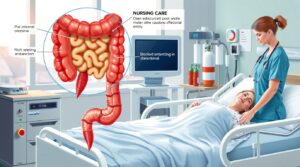
Note : Above image Generated by AI.
Click Here to Buy👉 Digestive Enzymes Postbiotics Prebiotics Probiotics for Women & Men
Causes of Intestinal Obstruction:
Intestinal obstructions can be broadly categorized as mechanical or non-mechanical.
-
Mechanical Obstruction: This involves a physical barrier blocking the lumen of the intestine.
-
Adhesions: Bands of scar tissue that form after abdominal surgery, which can twist or pull on the intestines. This is the most common cause of small bowel obstruction.
-
Hernias: Protrusion of an organ or tissue through a weak spot in the muscle wall, which can trap a loop of intestine.
-
Tumors: Malignant or benign growths that can grow into the intestinal lumen or press on it from the outside.
-
Volvulus: Twisting of the intestine on itself, often occurring in the large intestine.
-
Intussusception: Telescoping of one part of the intestine into another, more common in children.
-
Strictures: Narrowing of the intestine due to inflammation (e.g., Crohn’s disease), ischemia, or radiation.
-
Foreign bodies/Fecal impaction: Less common but can occur.
-
-
Non-Mechanical (Paralytic Ileus or Adynamic Ileus): This involves a decrease or absence of peristalsis (the wave-like contractions that move food through the intestines) without a physical blockage.
-
Post-surgical: Common after abdominal surgery due to manipulation of the bowels and anesthesia.
-
Electrolyte imbalances: Especially hypokalemia.
-
Medications: Opioids, anticholinergics.
-
Peritonitis: Inflammation of the peritoneum.
-
Spinal cord injuries:
-
Sepsis:
-
Click Here to Buy👉 Health Products
Types and Causes Of Intestinal Obstruction :
Intestinal obstructions are classified into two main types:
1. Mechanical Obstruction: A physical blockage prevents the passage of intestinal contents.
-
Luminal (Inside the Bowel):
-
Impacted Feces: Severe constipation, especially in the elderly.
-
Gallstones: A large gallstone can erode through the gallbladder into the intestine (gallstone ileus).
-
Foreign Bodies: Swallowed objects, bezoars (mass of hair or fiber).
-
-
Intramural (Within the Bowel Wall):
-
Tumors: Colorectal cancer is a common cause of large bowel obstruction.
-
Inflammation: Crohn’s disease, diverticulitis.
-
Strictures: Narrowing from scar tissue from previous surgery or radiation.
-
-
Extramural (Outside the Bowel Wall):
-
Adhesions: Bands of scar tissue from previous abdominal surgery. This is the most common cause of small bowel obstruction.
-
Hernias: Incarcerated or strangulated hernias (e.g., inguinal, femoral).
-
Volvulus: Twisting of a loop of intestine on itself (common in the sigmoid colon).
-
Intussusception: “Telescoping” of one segment of intestine into an adjacent segment (common in infants).
-
2. Non-Mechanical (Functional) Obstruction (Paralytic Ileus): There is no physical blockage, but the bowel’s normal peristaltic movements are temporarily paralyzed.
-
Causes: Abdominal surgery (most common), electrolyte imbalances (hypokalemia), infections (peritonitis), pancreatitis, trauma, medications (opioids), spinal cord injuries.
Pathophysiology Of Intestinal Obstruction :
The process follows a predictable sequence:
-
Obstruction: A physical or functional blockage occurs.
-
Accumulation: Gas and fluids accumulate proximal to (above) the obstruction. Gases are mostly swallowed air and, to a lesser extent, bacterial fermentation.
-
Distension: The bowel wall stretches and dilates due to the accumulation.
-
Increased Intraluminal Pressure: The pressure inside the bowel increases.
-
Impaired Blood Flow: The distension compromises blood flow to the bowel wall (ischemia). This can progress to tissue death (necrosis) and perforation.
-
Bacterial Proliferation and Translocation: Stasis of intestinal contents allows bacteria (e.g., E. coli, Klebsiella) to multiply rapidly. The compromised bowel wall can allow these bacteria and their toxins to leak into the peritoneal cavity (peritonitis) and the bloodstream (sepsis), leading to systemic shock.
Clinical Manifestations (Symptoms & Signs) Of Intestinal Obstruction :
The classic presentation depends on the level and type of obstruction.
Common Symptoms:
-
Abdominal Pain: Often described as crampy or colicky (comes in waves) in mechanical obstruction; constant and diffuse in paralytic ileus.
-
Nausea and Vomiting: Early and profuse with a proximal (high) small bowel obstruction. Vomitus may start as gastric contents, then become bilious (green), and later feculent (brown, foul-smelling) in lower obstructions.
-
Abdominal Distension: More pronounced in distal (low) obstructions and large bowel obstructions.
-
Constipation / Failure to Pass Flatus (Obstipation): A key sign of a complete obstruction. In a partial obstruction, there may be diarrhea.
Common Signs:
-
Abdominal Tenderness: Upon palpation.
-
Visible Peristaltic Waves: May be seen on the thin abdominal wall.
-
High-pitched, tinkling bowel sounds early in mechanical obstruction; absent bowel sounds in late-stage mechanical obstruction or paralytic ileus.
-
Dehydration: Dry mucous membranes, poor skin turgor, tachycardia, hypotension.
-
Fever: A late sign indicating possible ischemia, necrosis, or perforation.
Diagnostic Evaluation Of Intestinal Obstruction :
-
Abdominal X-Ray (Supine and Upright): Shows dilated loops of bowel with air-fluid levels. A “cut-off” point may be visible.
-
CT Scan (Computed Tomography): The gold standard. Provides detailed images to identify the location, cause, and severity of the obstruction, and to assess for signs of strangulation (ischemia).
-
Laboratory Tests:
-
CBC: Elevated WBC count suggests infection or ischemia.
-
Electrolytes: May show imbalances from vomiting and dehydration.
-
Lactate: Elevated serum lactate is a marker of tissue ischemia and shock.
-
-
Barium Enema: Can be both diagnostic (for intussusception or volvulus) and therapeutic.
Nursing Care Plan for Intestinal Obstruction :
A nursing care plan is a structured approach to patient care. Here is one for a patient with a suspected or confirmed intestinal obstruction.
Nursing Diagnosis 1: Acute Pain related to abdominal distension, intestinal cramping, and surgical incision.
| Outcome (Goal) | Nursing Interventions | Rationale |
| The patient will report a reduction in pain to a manageable level (e.g., 2-3 on a 0-10 scale) within 1 hour of intervention. | 1. Assess pain: Use a pain scale (0-10), note location, character, and frequency.
2. Maintain NPO (Nothing by Mouth) status and insert a nasogastric (NG) tube as ordered. 3. Administer analgesics as prescribed (e.g., opioids cautiously). 4. Provide non-pharmacological comfort measures: repositioning, back rubs, calm environment, distraction techniques. 5. Avoid enemas or laxatives. |
1. Provides a baseline to evaluate the effectiveness of interventions.
2. Decompresses the bowel, removing gas and fluid, which is the primary source of pain. 3. Provides direct relief from pain. Opioids must be used cautiously as they can worsen ileus. 4. Promotes relaxation and can reduce the perception of pain. 5. Can exacerbate pain and increase the risk of perforation in a complete mechanical obstruction. |
Nursing Diagnosis 2: Deficient Fluid Volume related to vomiting, fluid sequestration in the bowel, and inability to absorb oral intake.
| Outcome (Goal) | Nursing Interventions | Rationale |
| The patient will maintain adequate fluid balance as evidenced by stable vital signs, moist mucous membranes, good skin turgor, and urine output >30 mL/hr. | 1. Monitor vital signs frequently: Tachycardia and hypotension are signs of hypovolemia.
2. Assess for signs of dehydration: dry mucous membranes, poor skin turgor, sunken eyes. 3. Manage NG tube: Maintain on low intermittent suction; monitor output every shift. 4. Monitor intake and output (I&O) strictly, including NG output. 5. Administer IV fluids (e.g., Lactated Ringer’s, Normal Saline) as prescribed. 6. Monitor laboratory values: Electrolytes, BUN, Creatinine, Hemoglobin/Hematocrit. |
1. Early detection of fluid volume deficit and shock.
2. Provides clinical assessment of hydration status. 3. Prevents further accumulation of fluid in the stomach, reducing vomiting and fluid loss. 4. Provides an accurate picture of fluid balance. High NG output must be replaced mL-for-mL with IV fluids. 5. Replaces lost fluids and electrolytes, restoring circulatory volume. 6. Identifies electrolyte imbalances (e.g., hypokalemia, hyponatremia) that need correction. |
Nursing Diagnosis 3: Nausea related to bowel distension and obstruction.
| Outcome (Goal) | Nursing Interventions | Rationale |
| The patient will report relief from nausea and will not experience vomiting. | 1. Maintain NPO status and NG tube patency.
2. Administer antiemetic medications as prescribed (e.g., Ondansetron, Metoclopramide). 3. Provide oral care frequently with water or saline rinses. 4. Keep emesis basin out of sight when not in use; remove vomitus promptly. |
1. Eliminates the primary cause of nausea by preventing gastric distension.
2. Acts on the chemoreceptor trigger zone to reduce the sensation of nausea and prevent vomiting. 3. Vomiting and NPO status cause dry mouth and unpleasant taste, which can exacerbate nausea. 4. Reduces noxious stimuli that can trigger nausea. |
Nursing Diagnosis 4: Risk for Infection related to bacterial translocation, potential for perforation, and surgical intervention.
| Outcome (Goal) | Nursing Interventions | Rationale |
| The patient will remain free from signs of infection or sepsis, as evidenced by normal WBC count, afebrile status, and absence of purulent drainage. | 1. Monitor for signs of infection/peritonitis: fever, increasing abdominal pain/tenderness, rigid “board-like” abdomen, tachycardia, elevated WBC count.
2. Administer broad-spectrum IV antibiotics as prescribed. 3. Use strict aseptic technique when caring for the NG tube, IV sites, and surgical wounds. 4. Monitor surgical incision (if applicable) for redness, swelling, warmth, or drainage. |
1. Early recognition of peritonitis or sepsis is critical for survival.
2. Prophylactic antibiotics are given to prevent or treat infection from bacterial translocation. 3. Prevents the introduction of exogenous pathogens. 4. Identifies a surgical site infection early. |
Nursing Diagnosis 5: Anxiety related to acute illness, pain, uncertainty of diagnosis, and impending surgery.
| Outcome (Goal) | Nursing Interventions | Rationale |
| The patient will verbalize a decrease in anxiety and demonstrate use of effective coping strategies. | 1. Explain all procedures, tests, and treatments in simple, clear terms.
2. Encourage questions and provide honest answers. 3. Keep the patient and family informed of the progress and plan of care. 4. Provide emotional support and a calm presence. 5. Involve family in care as appropriate. |
Patient Education and Discharge Planning :
-
Post-Operative Care: If surgery was performed, teach about wound care, signs of infection, and activity restrictions.
-
Diet: Gradual advancement of diet as tolerated. A low-residue diet may be recommended initially.
-
Medication: Importance of taking prescribed medications, especially pain management and antibiotics.
-
When to Seek Medical Attention: Educate on “red flag” symptoms to report: recurrent abdominal pain, vomiting, fever, distension, or changes in the surgical incision.
-
Bowel Regimen: For patients with a history of constipation or adhesions, education on a high-fiber diet, adequate fluid intake, and activity to promote regular bowel movements.